
Today, 25 November, the world marks the International Day for the Elimination of Violence against Women. This year’s call is to UNiTE to end violence against women and girls: ensure justice, protect survivors, end impunity. We have sat with survivors long enough to know why those three verbs matter, and what the latest figures say about how far Nigeria still has to go.
Citing the 2024 Nigeria Demographic and Health Survey, UN Women’s representative in Nigeria noted that 21 percent of Nigerian women aged 15 to 49 have experienced physical or sexual violence, and 58 percent of survivors never seek help or report the abuse. Her explanation is worth sitting with: women stay silent not because they don’t need help, but because they doubt the systems meant to protect them will actually do so. Attitudes keep that silence in place. 22 percent of women and 16 percent of men in Nigeria still believe a husband is justified in beating his wife, and UNFPA reports that nearly 38 percent of Nigerian women aged 25 to 49 were married before the age of 18.
The cases that do reach a record are alarming enough. The Minister of Women Affairs says 2,755 cases were formally documented between January and April 2026, an average of 23 reported incidents a day, and the government has described the situation as a national emergency. Females account for 81% of survivors, and sexual violence makes up 82% of reported abuses, mostly affecting girls aged 10 to 14. These are only the cases that were written down. Given how many survivors never report, the true picture is almost certainly larger.
This is where “end impunity” stops being a slogan. Only four per cent of formally reported cases have been successfully prosecuted nationally, leaving 96 per cent unresolved. The minister has also acknowledged that Nigeria has only 50 shelter and support centres for its population and landmass, which she called clearly inadequate. The law is not the missing piece. The Violence Against Persons (Prohibition) Act has been on the books since 2015, and NAPTIP says 34 states have now domesticated it, with Kogi and Delta the only states yet to do so. The agency also reports more than 20 SGBV-related convictions, including three life sentences, and warns that technology-facilitated violence is emerging as an additional challenge. Still, as justice sector leaders acknowledged in March, stigma, economic barriers and institutional gaps keep many survivors from pursuing justice.
The cost is not carried by women alone. UN Women has said gender inequality and gender-based violence cost Nigeria an estimated 1.5% of its GDP annually. A country that cannot keep its women safe cannot build the stronger future it keeps promising.
Justice is only half of the answer. The other half is what happens after survival. A woman can leave a violent home and still carry it in her sleep, her trust and her body. That is why Freedom Foundation, through Genesis House, treats recovery as more than rescue, and why we believe healing is more than surviving.
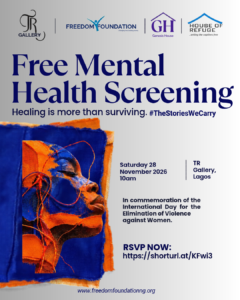
This Saturday, 28 November, at 10am, we are hosting free Counseling sessions at TR Gallery, Lagos, with our partner TR Gallery, under the theme #TheStoriesWeCarry. If you are a survivor, a caregiver, or someone who has carried something alone for too long, there is a seat for you RSVP HERE
Beyond that, the work belongs to all of us. Believe survivors the first time they speak, because how we respond decides whether they speak again. Challenge the jokes and the “it’s a family matter” excuses in your own circles. Know the reporting channels, including NAPTIP and your state ministry of women affairs, and use them. Safe women, stronger societies. It starts with refusing to look away.